
Blogs /

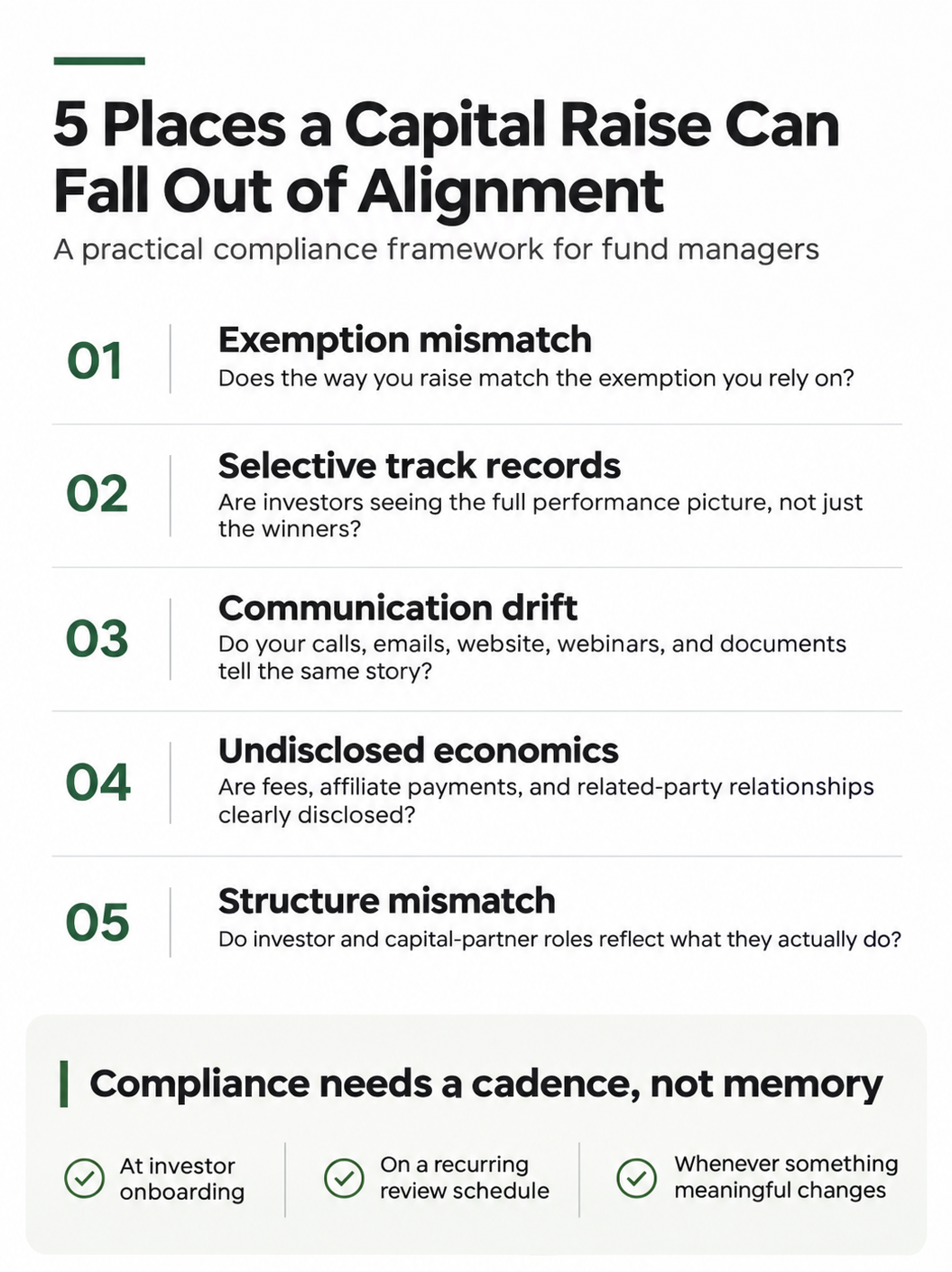
A capital raise can look compliant right up until the pieces stopmatching.
The documents may be signed. The filings may be made. The investorportal may be live. But if the offering is marketed, discussed, documented, oroperated differently from the structure behind it, a small inconsistency canbecome a much bigger problem.
That was a recurring theme in Avestor’s October 2026 LeadershipWebinar, where Avestor CEO Sanjay Vora and Co-founder Badri Malynurbroke down the pressure points that can put a private capital raise at risk,from exemptions to marketing and disclosures.
The practical lesson: compliance depends on keeping the entireraise aligned, not simply completing each task.
That alignment starts with the exemption behind the raise.
Capital raisers sometimes treat it as the legal wrapper around afundraising strategy already in motion. Sanjay’s warning was sharper: if youfall outside that exemption, the problem may not end with a fine.
He described the potential fallout of having to return investorcapital, possibly with interest, after that money has already been put to work.The SEC likewise warns that noncompliance with Securities Act registrationrequirements can give investors rescission rights. At that point, a complianceproblem can become an operating problem for the underlying investment.
That is why the exemption should shape the fundraising plan beforeoutreach begins. Under Regulation D, Rule 506(b) generally prohibits generalsolicitation, while Rule 506(c) permits it if all purchasers are accreditedinvestors and the issuer takes reasonable steps to verify that status.
The structure should inform how you raise, not be fitted around theraise afterward.
Once the structure is set, the next question is what investors arebeing shown.
Sanjay called out a common temptation when presenting pastperformance: “People have a tendency to talk about the good and ignore thebad.”
A manager may highlight winning deals and quietly leave weakerinvestments out. But a track record becomes less useful when investors cannotsee the context behind it.
The webinar emphasized clarity around the period shown, gross versusnet returns, and realized versus unrealized results. Advisers subject to theSEC’s marketing rule also face specific requirements intended to preventselective or misleading performance presentations.
Strong performance can help make the case. Selective performance canundermine it.
A complete track record is only part of the communication problem. Thenext risk is inconsistency.
Sanjay made the point plainly: “What you say carries the samestandard as what you print.”
Formal materials are rarely the only place an investor hears thestory. The offering may also be discussed on calls, webinars, email, podcasts,or the website.
A carefully drafted risk disclosure can be undermined if the spokenpitch suggests the investment is “safe,” guaranteed, or more certain than thedocuments support. Federal antifraud provisions apply to exempt offerings too,and the SEC says responsibility for false or misleading statements extends tooral and written communications.
The practical discipline is simple: the investor should hear thesame story everywhere.
The next place to look is the economics behind the deal.
Sanjay’s point was direct: “You have to disclose all money you’remaking. Period. Full stop.”
That includes more than obvious management or performance fees. If thesponsor, manager, or an affiliate is being paid elsewhere in the transaction,investors need to understand that relationship.
The webinar used the example of a sponsor who also owns theconstruction company or another service provider being paid by the deal.Changing the label does not remove the underlying conflict.
The exact disclosure obligations depend on the structure andregulatory status, but fees, affiliate compensation, and related-partyarrangements deserve explicit review.
If the economics are real, the disclosure should be real too.
The same principle applies to how investors and capital partners arestructured.
Sanjay pushed back on arrangements where passive investors are simplylabeled co-GPs: “Get 10 investors together, everybody’s a GP... That does notfly.”
His distinction was between people genuinely participating in andmanaging a joint venture and investors who contribute capital but remainpassive. Calling the latter “GPs” does not by itself settle how the arrangementis treated under securities law.
The webinar raised a related issue with capital partners. Sanjay notedthat a partner soliciting investors from their own network may need a separatecompliant structure or offering path. The analysis is fact-specific and shouldbe reviewed with securities counsel.
For fund managers, the practical rule is straightforward: structurethe relationship for what it actually is, not for what is convenient to callit.
The common thread is that compliance does not stay finished.
Avestor’s webinar framed the discipline around three recurringcheckpoints: when an investor onboards, on a regular review cadence, andwhenever something meaningful changes. The webinar deck similarly organizesits compliance checklist around investor onboarding, annual responsibilities,and changes that trigger review.
Revisit whether the structure, marketing, investor records,disclosures, and actual operations still tell the same story. Once those piecesdrift apart, the problem rarely stays contained to one document or filing.
If you’re thinking through the structure and operating infrastructurebehind your own capital raise, book a call with Avestor to see howthe platform can support your fund.
We believe clarity builds confidence. Here are answers to some of the most common questions we receive from sponsors, fund managers, and investors navigating private offerings.
Get in touch with us today!
Contact Us