


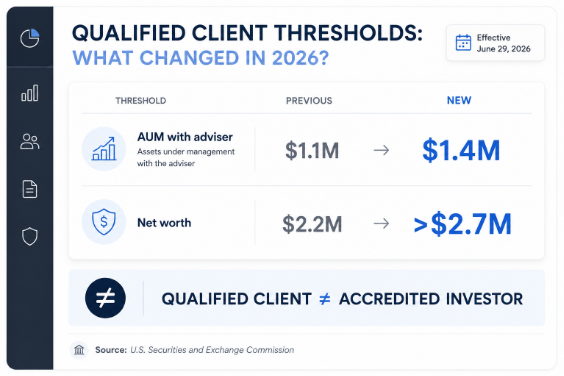
Two numbers changed on June 29, 2026: $1.4 million and $2.7 million.
Those are the new financial thresholds used in two tests for determining "qualified client" status under SEC Rule 205-3.
If your fund charges performance-based compensation and the rule applies to you, the change could affect how new investors are qualified and how your subscription and onboarding processes are set up.
But that's not the only private-fund regulation worth watching.
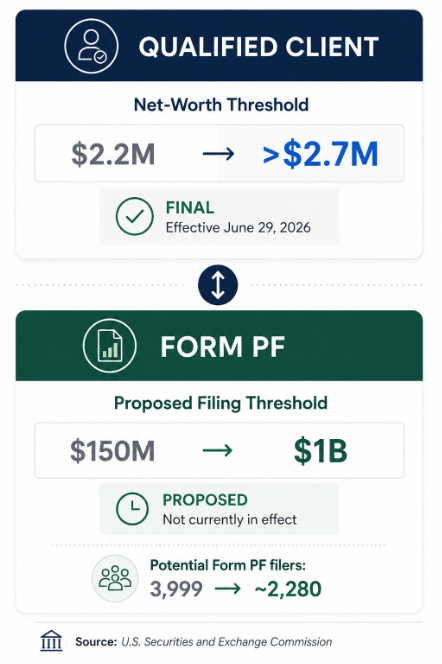
The SEC and CFTC are also considering raising the general Form PF filing threshold from $150 million to $1 billion; a proposal that could eliminate the filing requirement for almost half of current filers.
One change is already here. The other could materially reduce reporting for thousands of advisers. Here's what fund managers need to know.
Qualified Client Is Not the Same as Accredited Investor
This is the most important distinction to understand.
An accredited investor meets SEC criteria commonly used to determine who can participate in certain private securities offerings.
A qualified client is different. Rule 205-3 addresses when investment advisers can charge certain performance-based compensation. One way a client can qualify is by meeting either an assets-under-management or net-worth test.
As part of a scheduled inflation adjustment, the SEC raised both thresholds:

The key takeaway: the SEC did not raise the accredited investor threshold to $2.7 million.
If Rule 205-3 applies to your arrangement, however, the new qualified-client thresholds may matter when charging performance-based compensation.
So, the first question isn't whether your investors are accredited. It's whether Rule 205-3 applies to your fund and compensation structure.
What Fund Managers May Need to Update
The new thresholds generally apply to contractual relationships entered into after the effective date. Rule 205-3 also contains transition provisions for relationships that satisfied the rule when they were established.
That means managers should avoid treating this as a simple find-and-replace exercise.
An investor's existing relationship with one fund should not automatically be treated as resolving qualification for every future relationship.
Rule 205-3 provides that when a new person becomes party to an arrangement, including becoming an equity owner of an advised private investment company, the conditions in effect at that time apply to that person.
This becomes particularly important for managers operating multiple funds, SPVs, or series.
The practical question isn't simply whether an investor qualifies. It's which investor, which vehicle, and which version of the rule applies.
Form PF May Be Moving in the Opposite Direction
While qualified-client thresholds increased, regulators are considering reducing reporting requirements for many private fund advisers.
In April 2026, the SEC and CFTC proposed increasing the general Form PF filing threshold from $150 million to $1 billion in private fund assets under management.
The potential impact is significant.
Using Q1 2025 Form PF data, the SEC estimates that the $1 billion threshold would reduce the number of Form PF filers from 3,999 to approximately 2,280.
Yet Form PF would still capture approximately 94% of private fund gross assets, compared with approximately 96% under the current threshold.
But this is a proposal, not the current rule.
Separately, the SEC and CFTC extended the compliance date for Form PF amendments adopted in 2024 to October 1, 2026, providing additional time for a substantive review of Form PF.
Managers should therefore continue operating under current requirements unless and until the proposed changes become final.
The Bigger Risk Is Operational Lag
A regulatory threshold can change overnight.
Your operation may have that threshold embedded in ten different places.
That's where a relatively small regulatory change becomes a scaling problem.
As managers add investors, offerings, SPVs, asset classes, and ongoing subscriptions, those touchpoints multiply.
Updating the subscription agreement does little if the investor questionnaire still uses an old threshold. Updating both is not enough if the onboarding workflow applies outdated qualification logic.
This is why fund infrastructure matters.
This is particularly relevant for managers using a Customizable Fund® to invest across multiple opportunities or asset classes.
Avestor brings fund formation, investor onboarding, administration, and ongoing operations into one ecosystem, reducing the number of disconnected processes a manager has to maintain as the fund evolves.
What Should Fund Managers Do Now?
For managers who may be affected by Rule 205-3, five steps are worth taking now:
1. Confirm whether the rule applies.
Review your adviser status, compensation structure, and fund structure with securities counsel.
2. Separate existing and new relationships.
Don't assume the new thresholds apply identically to every investor already in your fund.
3. Search for the old thresholds.
Look for $1.1 million and $2.2 million across subscription agreements, investor questionnaires, advisory agreements, offering materials, transfer documents, investor portals, and digital onboarding workflows.
4. Review every active vehicle.
A change made to one fund or SPV may not carry over to another. Include templates reused across funds, SPVs, or series.
5. Keep Form PF changes in perspective.
The proposed $1 billion filing threshold is not final. Continue operating under current requirements unless and until the proposal is adopted.
The Rule Changed. Can Your Fund Change With It?
The qualified-client update changed two numbers. The harder part is making sure those numbers change everywhere they need to.
As funds add investors, strategies, and opportunities, that becomes an infrastructure problem, not just a compliance task.
Avestor's Customizable Fund® brings fund formation, investor onboarding, administration, and ongoing operations into one connected ecosystem, helping managers build for growth without adding disconnected processes at every step.
Explore the Customizable Fund® →
Disclaimer: This article is for informational and educational purposes only and does not constitute legal, tax, investment, compliance, or regulatory advice. Fund managers should consult qualified legal and compliance professionals regarding their specific circumstances.