



The biggest mistake a first-time fund manager can make isn't choosing the wrong fee structure.
It's assuming there's a standard one to begin with.
Your fee structure isn't just a pricing decision. It's a business decision. Yet many managers begin with what's common instead of what's appropriate for their strategy.
Someone tells them venture funds charge "2 and 20." A real estate sponsor shares their waterfall. Another manager sends over their operating agreement. Eventually, the fee model stops feeling like a choice and starts feeling like the standard.
That's exactly the assumption Avestor co-founder Badri Malynur challenged during this month's leadership webinar.
"I don't necessarily want you to walk away thinking that this is the only way to structure a fund."
He wasn't criticizing the fee model. He was challenging the assumption that there is one "right" way to structure a fund.
A fund isn't just an investment strategy; it's a business. Every business has operating costs, cash flow, and decisions about how it sustains itself. Your fund's economics should solve those realities first. The fee structure comes later.
A venture fund may wait years before generating liquidity. A cash-flowing real estate fund may begin producing income almost immediately. Yet it's easy to assume those businesses should follow the same economic model.
They don't.
The best fee structure isn't the one that's most common.
It's the one that fits how your fund actually creates value.
How to Structure a Private Fund Management Fee?
Most managers know the numbers.
2% management fee.
20% carried interest.
But knowing the numbers isn't the same as knowing why they exist.
The mistake is assuming those numbers answer the real question. Before you decide how much to charge, you need to answer something far more practical:
How will your fund pay its bills before it generates returns?
- Legal.
- Compliance.
- Fund administration.
- Accounting.
- Investor reporting.
- Your own time.
Those costs exist whether your investments generate returns next quarter or five years from now. Using an industry-standard fee model doesn't make them disappear.
That's exactly the challenge Saket Jain, one of Avestor's fund managers faced while building Scalpel Ventures.
As he put it:
"It's always going to be, how are we going to keep the fund lights on?"
The real question isn't whether 2% is justified. It's whether your fund's economics can support the business you're trying to build.
When designed well, a management fee isn't just paying the manager. It's helping the fund operate the strategy investors signed up for.
How Should a Fund Cover Expenses Before It Generates Returns?
Many first-time fund managers simply pay expenses out of pocket and reimburse themselves later.
It works.
Until the fund grows.
As Saket Jain put it:
"That's possible... but that's not scalable."
Rather than relying on the manager to absorb those costs, Scalpel Ventures designed the fund so operating expenses were accounted for from day one.
For every investment, a portion of contributed capital is held in reserve.
For example: on a $100,000 investment:
- $80,000 is deployed into the investment.
- $20,000 is reserved for management fees and operating expenses. The reserve is drawn over time as costs are incurred, not all at once. If money remains after the investment exits, it's returned to investors rather than retained by the manager.
The percentage itself isn't the insight. The thinking behind it is.
The reserve wasn't designed to follow an industry standard. It was designed to solve a business problem.
That's the real lesson.
Strong fund economics don't come from starting with percentages. They come from understanding what your strategy needs to operate successfully.
If you're thinking through different ways fund economics can support both your strategy and long-term operations, we've also explored this in The Income Economics Behind a Customizable Fund®.
Start With the Cash Flow, Not the Fees
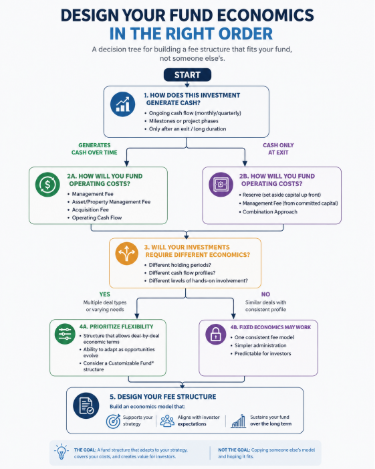
Almost every decision about your fund's economics comes down to one question: When does this fund generate cash?
Cash flow determines how long your fund has to operate before value is realized, and that's what ultimately drives how the business should be financed.
If the answer is only after an exit, your fee structure needs to support years of operating before investors see a return.
If the answer is through ongoing operations, you have far more flexibility. That's why two equally successful funds can justify completely different economics.
One may rely on reserves.
Another may rely on acquisition fees.
Another may generate enough operating income to cover expenses naturally.
Cash flow dictates economics.
Economics dictate fees.
Design them in that order.
Most Fund Structures Assume Every Deal Is the Same
Designing the right fee structure is only half the challenge. The other half is what happens when your next deal looks nothing like your last one.
Maybe your first investment produces quarterly cash flow.
The second won't generate a dollar for five years.
The third requires a completely different operating model.
Should all three have identical economics?
Most traditional fund structures are designed as though they should. Once the documents are signed, the economics are largely fixed across every investment.
As Saket Jain explained:
"The flexibility is also important on a deal-by-deal basis..."
Instead of forcing every investment into the same fee model, Scalpel Ventures can tailor the economics to fit each opportunity while operating under a single legal structure.
For managers raising capital across different types of opportunities, that flexibility isn't just convenient; it's structural.
This is one of the ideas behind Avestor's Customizable Fund® structure.
Managers can raise capital through a single fund while tailoring each deal's economics to how that investment creates value.
A cash-flowing real estate acquisition doesn't have to follow the same economic structure as a long-duration venture investment.
The structure adapts to the strategy, not the other way around.
If you're new to the concept, here's a deeper look at how a Customizable Fund® works and why many managers are switching to it.
Design Your Economics Before You Draft Your Documents
Too many managers start with legal documents.
The better starting point is economics.
Before deciding on management fees, reserves, acquisition fees, or promotes, work through a few fundamental questions:
- When does this investment generate cash?
- What will it cost to operate until then?
- How should those costs be shared with investors?
- If the deal performs better than expected, who benefits from any unused reserve?
- Will future deals require different economics, or are you comfortable locking every investment into the same structure?
Answer those questions first.
Your economics become clearer.
Your fee structure follows.
Then your documents simply reflect those decisions.
The documents should reflect your economics, not define them.
Build the Business First. The Fee Structure Will Follow.
Most fund managers spend months refining their investment strategy.
Very few spend the same amount of time designing the business behind it.
Every fund has its own cash flow, operating model, investor expectations, and timeline.
That's why Badri and Saket weren't really discussing management fees or reserves. They were discussing how to design a fund that could actually sustain the strategy behind it.
That same philosophy is what shaped Avestor's Customizable Fund® structure.
Instead of forcing every investment into one set of economics, managers can build a fund that adapts to different strategies while operating under a single legal framework.
Your investment strategy tells investors how you'll create value.
Your fund economics determine whether you can keep doing it.
If you're evaluating how to structure your fund, Avestor can help you think through the economics before they're written into legal documents.