Blogs /

There’s a pattern most fund managers don’t talk about.
The first raise works.
The second is harder.
By the third, something feels off.
Conversations take longer. Conversions drop.
The same strategies that once worked start producing diminishing returns.
It’s easy to blame the market.
In 2026, fundraising has become more difficult.
Those are real constraints. But they’re not new enough to explain the pattern we’re seeing.
Because if the problem were just “less capital,” then no one would be raising consistently.
But some managers still are and they’re not fundamentally different in strategy, asset class, or opportunity set.
So, what changed?
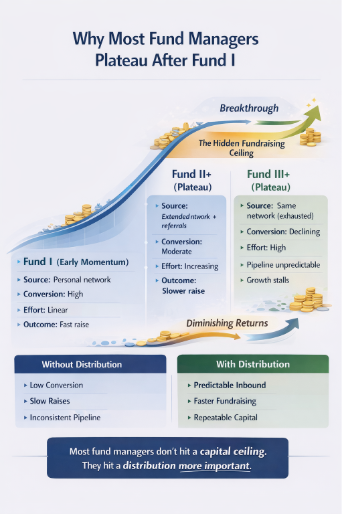
Most fund managers don’t fail because they can’t raise capital.
They fail because they can’t keep raising it.
The second raise stretches that network.
The third raise exposes the limit of it.
Because at that point, you are no longer raising from your network. You are trying to raise beyond it, and most fundraising models were never designed for that.
This is the part most people miss.
You don’t run out of capital.
You run out of reach.
The traditional fundraising model is linear:
More conversations → more capital
At some point, it doesn’t and when it stops, it doesn’t fail loudly. It just slows quietly. That’s the moment most capital raisers misdiagnose the problem.
Ten years ago, you could build a successful fund on:
That model still works for a while.
But today, the environment is less forgiving.
Which means something subtle but important has changed: fundraising is no longer judged at the moment of the raise. It’s judged continuously.
Investors are evaluating:
Not just whether the deal is attractive.
This is the transition most capital raisers haven’t fully internalized yet. Fundraising is no longer an event. It’s a system, and systems behave differently.
They require:
A modern fundraising system has three layers:
Most fund managers only build the second layer, which is why they tend to plateau.
This is where the conversation around Reg A becomes important, because it’s often misunderstood. Many fund managers approach structures like Reg A as a solution to fundraising.
But that’s not quite right. A better way to think about it is this:
Structure expands the opportunity.
Distribution determines whether you capture it.
Under Reg D:
Under Reg A:
That’s not a small shift.
It changes:
But expanding access doesn’t automatically translate into capital, because once access expands, the nature of fundraising changes.
You are no longer:
You are now operating in a world where:
This is why some Reg A issuers are able to raise $25M–$75M annually, while others struggle to gain traction. The difference is not the structure. It’s whether the manager is equipped to operate at that level.
Reg A doesn’t remove the need for distribution.
It makes distribution more important.
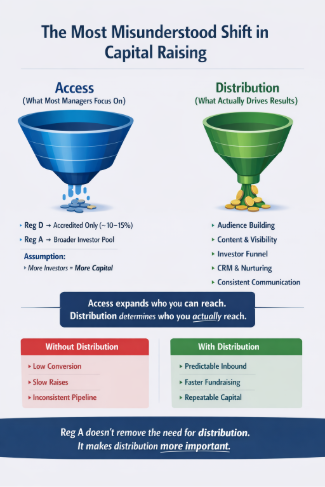
This is where most managers lack clarity. A fundraising system is not just “doing more marketing.” It’s a coordinated pipeline.
It looks like this:
Without this system:
With it:
Let’s say you solve distribution.
You reach more investors. You generate more interest. You expand beyond your network.
Now a new problem appears. Scale. More investors means:
And this is where many managers break.
Because they were not designed to handle:
So, the constraint shifts:
From: “How do I find investors?”
To: “How do I manage them without losing trust?”
Most fund managers still ask: “How do I raise for this fund?”
But that question keeps them stuck in a loop.
The better question is: “How do I build a system that allows me to raise capital repeatedly without starting from zero each time?”
Because that’s where the advantage compounds.
Once fundraising becomes:
You need infrastructure that supports:
Not as disconnected tools. But as a unified system.
This is where platforms like Avestor naturally fit, not as a replacement for distribution, but as the layer that supports it once it starts working. Because scale doesn’t just require reach.
It requires coordination.
Capital hasn’t disappeared. Access isn’t the real constraint.
The real constraint is whether you’ve built something that can consistently reach, convert, and retain it.
Because the uncomfortable truth is this: most fund managers are not competing for capital. They are competing for distribution capacity, and the ability to operate at scale once they achieve it.
The ones who recognize that early will build systems that compound.
The rest will keep doing what worked before, and slowly wonder why it doesn’t work anymore.
If you’re starting to think about how your current setup would handle scale, or where it might break, it’s worth having that conversation early.
We believe clarity builds confidence. Here are answers to some of the most common questions we receive from sponsors, fund managers, and investors navigating private offerings.
Get in touch with us today!
Contact Us