Blogs /

Private markets are entering a new phase of regulatory attention.
On March 4, 2026, the U.S. Securities and Exchange Commission hosted a Private Markets Roundtable bringing together regulators, asset managers, legal experts, auditors, and ratings agencies to discuss three topics increasingly shaping the industry:
• Retail access to private markets
• Fund governance expectations
• Valuation oversight
The discussion reflected a broader shift happening across private markets.
Assets historically offered only to institutional investors are increasingly appearing in publicly offered vehicles, creating a new environment where private market strategies and retail investors may intersect.
As SEC Director of Investment Management Brian Daly noted in opening remarks, the goal of the discussion was to explore how the industry can support what regulators describe as “responsible retailization.”
That goal immediately places governance and valuation practices at the center of the conversation.
Private markets have grown dramatically over the past decade.
According to Preqin’s 2025 Global Private Markets Report, private market assets under management exceeded $14 trillion globally, with projections approaching $20 trillion by 2030.
At the same time, asset managers are increasingly developing structures that expand access to private assets through:
• Interval funds
• Semi-liquid structures
• Tender offer funds
• Publicly registered vehicles
These developments are blurring the lines between public and private market investment structures.
The SEC’s roundtable addressed what happens when those two worlds begin to collide.
The first panel of the roundtable focused on a structural shift occurring across the asset management industry.
Private market strategies that historically operated within closed institutional structures are increasingly being introduced into public investment vehicles.
Panel participants included senior leaders from organizations such as:
• AQR Capital Management
• Blackstone
• PwC
• Moody’s Ratings
The discussion explored several core questions:
• What opportunities does broader investor access create?
• What risks emerge when private assets meet public investor expectations?
• How should valuation and liquidity considerations be communicated?
For regulators, the key issue is not simply expanding access. It is ensuring that access happens with clear governance standards and investor protections in place.
This is why valuation transparency and operational infrastructure are increasingly being viewed as foundational to the future of private markets.
The second panel focused directly on fund governance and valuation oversight.
Participants included professionals from:
• PwC
• Deloitte
• Cleary Gottlieb Steen & Hamilton LLP
• Cliffwater
• Comply
The discussion addressed a question becoming more common across the industry:
As private market exposure expands, how should governance practices evolve?
Panelists discussed areas including:
• oversight frameworks for private asset valuation
• compliance expectations under Rule 2a-5
• operational challenges associated with illiquid assets
• emerging governance best practices
Historically, valuation governance has often been treated as a technical back-office function.
But as private markets become more visible and accessible, governance practices are increasingly becoming a front-of-house credibility issue.
Investors want confidence not only in investment strategy, but in how assets are valued and monitored over time.
Unlike public equities, private market assets rarely have continuously observable prices.
Valuations often depend on models that incorporate:
• comparable transactions
• projected cash flows
• market assumptions
• internal analysis
This introduces judgment. That judgment must be supported by clear governance structures.
Institutional investors have long expected this level of oversight.
However, as regulators consider broader access to private markets, consistent valuation governance is becoming a systemic trust issue, not just an internal process.
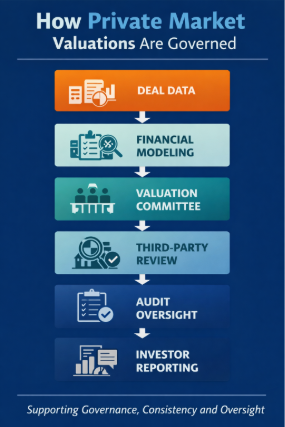
The roundtable did not introduce new regulatory rules. But the themes that emerged provide useful signals about where expectations may be heading.
For fund managers, several practical considerations stand out.
Managers should ensure valuation methodologies are formally documented within compliance frameworks.
Valuation committees, external valuation providers, and audit processes provide credibility during investor diligence.
Valuation language should align across:
• offering memoranda
• marketing materials
• investor reporting
Inconsistencies often become friction points during due diligence.
Investors want clarity around how private assets are valued between liquidity events.
Transparency tends to reduce questions later.
One phrase used repeatedly during the roundtable discussion was “responsible retailization.”
The idea reflects a broader shift in how regulators and asset managers think about the future of private markets.
Access may expand, but governance standards must evolve alongside it.
Private markets involve:
• illiquidity
• valuation subjectivity
• longer investment horizons
As a result, ensuring that investors understand how assets are valued and monitored becomes critical.
For many industry participants, the challenge is not whether access expands.
It is how to ensure that expansion occurs without weakening investor protections.
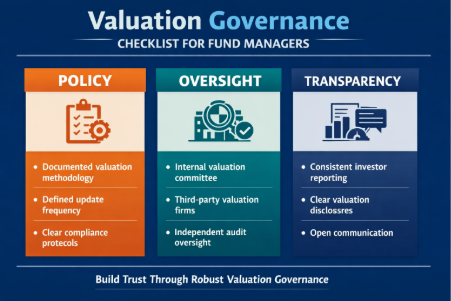
The SEC roundtable did not introduce immediate regulatory changes. But it did highlight an important shift in the private markets conversation.
As the industry grows and access broadens, operational practices that once remained behind the scenes are becoming more visible.
These are no longer purely internal considerations. They are increasingly part of the investor confidence equation.
For fund managers planning future growth, the takeaway is straightforward.
Strong investment strategies matter. But increasingly, so does the infrastructure that supports them.
As private markets continue evolving, expectations around valuation transparency, governance, and operational clarity are becoming more visible during investor diligence.
Many fund managers already have strong investment strategies. The question increasingly becoming relevant is whether the infrastructure behind the fund supports those expectations as it scales.
If you’re evaluating how your current setup supports governance, reporting, and repeat capital raises, it can be helpful to compare notes with operators working through similar challenges.
Book a conversation with the Avestor team to explore how fund infrastructure is evolving across private markets.
👉 Book a call
We believe clarity builds confidence. Here are answers to some of the most common questions we receive from sponsors, fund managers, and investors navigating private offerings.
Get in touch with us today!
Contact Us