



This year marked a pivotal shift in how capital is raised. At Avestor, we’ve had a front-row seat for these changes. With over 500 operators, sponsors, capital allocators, and fund managers on our platform, we had the opportunity to see new trends emerging. We expect these trends to accelerate in 2026.
In this year-end recap, we’ve brought together the most meaningful capital raising trends of 2025, not as predictions, but as signals. Each reflects how investors are thinking, how operators are adapting, and where private markets are heading next.
If you plan to raise capital in 2026, understanding these shifts will be critical. From evolving fund structures and changing investor preferences to deeper due diligence expectations and the growing role of automation, the following trends highlight what’s shaping successful capital raising today, and what will matter even more in the year ahead.
The Trends Shaping Capital Raising
- Trend 1: The Acceleration of Fund-of-Funds Structures
- Trend 2: The Shift from Equity Investments to Debt Investments
- Trend 3: Due Diligence Squared. Burned Investors Are Smarter Now
- Trend 4: New Asset Classes Are Gaining Momentum
- Trend 5: Sales Automation Is Becoming Critical for Capital Raising Success
Trend 1: Acceleration of Fund-of-Funds Structures
One of the clearest structural shifts we observed in 2025 was the growing adoption of fund-of-funds (FoF) models across private markets.
Historically, fund-of-funds structures were associated with large institutions seeking diversification across managers. In 2025, that same logic began to resonate with independent sponsors, syndicators, and capital allocators operating at a smaller scale.
The driver is simple: risk management and efficiency.
Rather than committing capital to a single strategy, asset, or sponsor, investors increasingly preferred exposure to multiple underlying funds or operators within a single allocation. This approach helped smooth performance, reduce concentration risk, and simplify decision-making, especially in volatile or uncertain market conditions.
From the operator’s perspective, fund-of-funds structures also addressed a growing operational challenge: managing investor expectations across different timelines, risk profiles, and asset types. By packaging diversification into the structure itself, sponsors were able to align investors more effectively from the outset.
As we move into 2026, we expect fund-of-funds models to continue gaining momentum, particularly among capital allocators and family offices looking for broader exposure without increasing complexity.
Why this trend matters for 2026:
Investors are prioritizing diversification and downside protection. Fund-of-funds structures offer a scalable way to meet those expectations while maintaining clarity and alignment.
Trend 2: The Shift from Equity Investments to Debt Investments
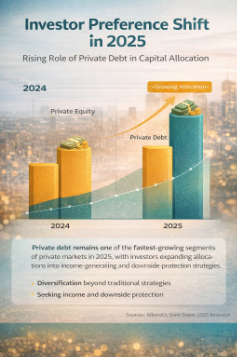
Another defining trend of 2025 was the noticeable shift in investor preference from equity-heavy strategies toward debt-focused investments.
After years of strong equity performance, many passive investors entered 2025 more cautious and outcome-driven. Market volatility, extended hold periods, and delayed exits made one thing clear: predictability mattered more than upside potential.
Debt investments, particularly private credit, structured debt, and income-producing notes, offered what many investors were seeking:
- Shorter duration
- More predictable cash flow
- Faster return of capital
This shift was especially pronounced among passive investors who had previously experienced capital being locked up longer than expected in equity deals. In response, they began favoring strategies that emphasized regular payouts and capital preservation over speculative growth.
For capital raisers, this meant rethinking product mix and investor communication. Debt-focused offerings required clearer explanations of risk, structure, and yield, but they also aligned more closely with what investors wanted in the current environment.
Why this trend matters for 2026:
Demand for private debt and income-oriented strategies is likely to remain strong as investors continue to prioritize cash flow, liquidity awareness, and downside protection.
Trend 3: Due Diligence Squared. Burned Investors Are Smarter Now
If there was one behavioral shift that defined investor sentiment in 2025, it was this: investors became far more diligent and far more skeptical.
Many investors entered prior cycles relying heavily on polished pitch decks, strong narratives, and projected returns. When market conditions tightened, some of those investments underperformed or failed altogether. The result was a more cautious, informed investor base.
In 2025, investors no longer stopped at surface-level materials. Instead, they focused on:
- Sponsor track records and decision-making history
- Alignment of incentives
- Operational competence
- Risk management practices
- Deal-level assumptions and downside scenarios
This evolution wasn’t about distrust; it was about experience.
Burned investors didn’t stop investing; they simply invested more intentionally. They asked better questions, took more time, and sought deeper understanding before committing capital.
For capital raisers, this raised the bar. Clear documentation, transparent communication, and credible operating history became non-negotiable. Those who could meet these expectations built stronger investor relationships; those who couldn’t struggled to raise.
Why this trend matters for 2026:
Investor sophistication will continue to increase. Capital raising success will depend less on marketing polish and more on substance, transparency, and trust.
Trend 4: New Asset Classes Are Gaining Momentum
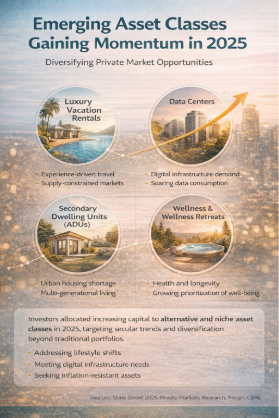
While traditional asset classes remained important in 2025, we also saw growing interest in non-traditional and emerging asset classes, particularly those tied to demographic shifts, lifestyle changes, and infrastructure demand.
Some of the asset classes gaining momentum included:
- Luxury vacation rentals in experience-driven markets
- Accessory Dwelling Units (ADUs) and Secondary Dwelling Units (SDUs)
- Wellness retreats and health-focused real estate
- Data centers and digital infrastructure assets
What these asset classes had in common was clear demand drivers. Whether it was housing shortages, remote work trends, aging populations, or data consumption growth, these strategies addressed real-world needs rather than speculative cycles.
Investors were drawn to these opportunities not because they were novel, but because they were thematically grounded and often less correlated with traditional market movements.
Why this trend matters for 2026:
As investors seek diversification beyond traditional real estate and equity strategies, emerging asset classes with strong fundamentals will continue to attract attention and capital.
Trend 5: Sales Automation Is Becoming Critical for Capital Raising Success
The final major trend of 2025 wasn’t about fund structure or asset class; it was about how capital is raised in practice.
As investor acquisition channels expanded, capital raisers found themselves managing:
- Higher inbound lead volume
- Multiple touchpoints before commitment
- Longer decision cycles
- More complex follow-up and education requirements
Traditional, manual approaches, spreadsheet tracking, one-off emails, informal follow-ups struggled to keep pace.
In contrast, capital raisers who invested in sales automation and front-end systems saw more consistent results. This included:
- CRM implementations
- Automated email sequences
- Structured onboarding workflows
- Clear lead qualification processes
Automation didn’t replace relationships; it supported them. By handling repetitive tasks and ensuring consistent communication, these systems allowed sponsors to focus on higher-value conversations and investor alignment.
Why this trend matters for 2026:
As competition for investor attention increases, capital raisers who rely on scalable, automated systems will be better positioned to convert interest into committed capital.
Conclusion
Looking ahead to 2026, one thing is clear: capital raising is becoming more intentional on all sides of the market. Investors are asking better questions, operators are rethinking structures, and systems are replacing ad-hoc processes that no longer scale.
For fund managers, sponsors, and capital allocators planning to raise capital in 2026, the opportunity isn’t just to follow these trends, but to understand how they fit together and what they mean for long-term strategy.
If you’re thinking through how these dynamics might impact your next offering or overall capital strategy, having an informed conversation early can help bring clarity. Our team is always open to discussing how others in the market are approaching these changes and what we’re seeing across the broader private markets.
If it’s helpful, you’re welcome to book a conversation with Avestor to explore how these trends may apply to your plans for 2026.