


Why Scalable Capital Raising Is Built on Systems, Not Hustle
Raising capital rarely fails because of a lack of opportunity.
More often, it breaks down because the underlying systems were never designed to scale.
Fund managers typically start with momentum: a strong deal, early investor interest, and the confidence that growth will naturally follow. But as capital raising expands, complexity compounds. Structuring decisions, compliance requirements, investor communication, back-office operations, and marketing efforts begin to overlap, and without the right foundation, progress slows.
At Avestor, we’ve worked closely with hundreds of fund managers, sponsors, and capital raisers across real estate, private credit, venture, and alternative assets. Over time, a consistent pattern emerged: the managers who scaled with clarity weren’t doing more; they were operating within better-designed systems: Systems that connected onboarding, compliance, investor communication, and operations into a single, repeatable workflow.
That system is what we refer to as Avestor’s 6 Pillars of Growth.
Not as features, but as structural foundations behind scalable capital raising.
Why Capital Raising Breaks as Funds Grow
Most capital-raising challenges don’t appear on day one. They surface after momentum builds.
We often see friction emerge when:
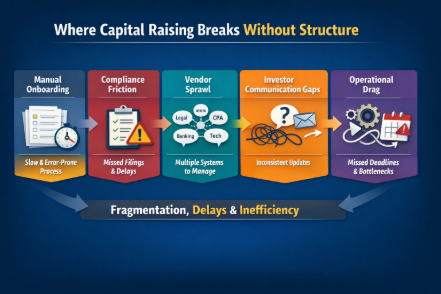
- Investor onboarding stretches from hours to days
- Compliance becomes something handled “after the raise”
- The same investor questions repeat every deal
- Spreadsheets, email threads, and PDFs become the system
- Tax season exposes reporting gaps
- Launching a new offering requires rebuilding processes from scratch
These issues aren’t caused by poor execution. They’re symptoms of infrastructure that was never meant to handle growth.
If this pattern feels familiar, we explored why deal-by-deal capital raising often creates these exact bottlenecks as funds grow.
👉 Read: Why Raising Capital Deal-by-Deal Might Be Slowing You Down
If two or more of these feel familiar, your infrastructure is likely under strain:
- “New raises take longer than previous ones”
- “Investor questions increase each deal”
- “Compliance tasks feel reactive”
- “Tax season creates investor frustration”
The Pattern We’ve Seen Across Hundreds of Fund Managers
Across funds that scaled predictably, one pattern kept repeating: growth accelerated once structure replaced improvisation.
The fund managers who avoided plateaus invested early in:
- Repeatable onboarding
- Built-in compliance
- Consistent investor experience
- Fewer operational handoffs
Importantly, they weren’t using more tools; they were using fewer, better-integrated systems.
This distinction matters, because most platforms in private markets are designed to solve one problem well, not the full capital-raising lifecycle, which works early on, but becomes a constraint as funds grow.
Why Most Platforms Only Solve Part of the Problem
It’s common to see platforms focused on:
- Investor onboarding
- Document signing
- Education
- Compliance support
- Networking
Each solves a real need. But when these capabilities live in separate tools, the hidden cost is fragmentation.
Fragmentation shows up as:
- Duplicated data
- Inconsistent investor experience
- Delayed execution
- Reliance on manual coordination at critical moments
What separated the fastest-scaling managers wasn’t access to better features; it was having these capabilities designed together as one operating system.
That’s where the 6 Pillars of Avestor come in.
Pillar 1: Technology
Making Capital Raising Repeatable
As funds grow, manual processes stop scaling.
Successful fund managers replace ad hoc workflows with technology that standardizes investor onboarding, compliance, documentation, and fund flows. The goal isn’t speed alone; it’s consistency and risk reduction.
We often see the first breaking point after a manager’s third or fourth raise, when onboarding timelines slow and errors begin to surface.
Best practice: design onboarding and compliance as infrastructure, not tasks.
What this enables: predictable raises, fewer delays, and cleaner execution.
This is the foundation Avestor’s technology pillar is built to support.
Pillar 2: Services
Reducing Operational Drag Through Structure
As complexity increases, coordination becomes a hidden tax.
Legal, compliance, banking, accounting, and tax often sit with separate vendors, each with different timelines and incentives. Managers feel this most during launches and reporting cycles.
Scalable managers move away from coordination-heavy setups toward structures where services are integrated into the workflow itself.
Best practice: fewer handoffs, clearer ownership, and aligned timelines.
What this enables: lower overhead and more focus on capital strategy.
Pillar 3: Community
Accelerating Growth Through Shared Experience
Capital raising improves faster through context than trial-and-error.
Managers who scale efficiently learn from peers who’ve already navigated similar challenges, whether that’s fund structuring, investor communication, or operational decisions.
We often see community impact most clearly when managers are preparing to launch or restructure and want to pressure-test decisions before committing.
Best practice: learn inside an ecosystem where collaboration can move directly into execution.
What this enables: faster clarity, fewer mistakes, and stronger partnerships.
Pillar 4: Education
Turning Knowledge into Confident Execution
Many capital-raising mistakes aren’t operational; they’re conceptual.
Fund managers make reactive decisions around structure, compliance, or investor terms because they lack context, not effort. Education bridges that gap.
The most effective managers invest in understanding trade-offs before they’re forced to make them.
Best practice: continuous learning tied to real decisions, not theory.
What this enables: clearer communication, stronger judgment, and confidence under pressure.
Pillar 5: Marketplaces
Visibility That Scales With Structure
Visibility only compounds when the foundation is sound.
Manager-to-manager marketplaces support collaboration and co-investment. Investor marketplaces expand reach beyond personal networks. But without structure, visibility creates noise instead of leverage.
We’ve also seen investor discovery shift significantly in recent years. This breakdown explores why marketplaces have become a more effective channel when layered on top of the right structure.
👉 Read: Investor Marketplaces and How Investors Discover Opportunities Today
We consistently see marketplaces work best when layered on top of compliant fund structures and consistent onboarding, not bolted on as growth tactics.
Best practice: visibility that aligns investors early.
What this enables: better-fit capital and more efficient conversations.
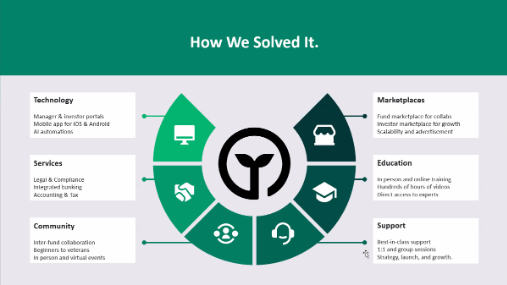
Pillar 6: Support
Guidance at Key Inflection Points
Even with strong systems, judgment matters.
Fund launches, restructures, compliance questions, and investor issues are moments where decisions carry outsized impact. Managers who scale sustainably have access to experienced guidance when those moments arise.
Support matters most not in routine operations, but when uncertainty is high.
Best practice: experienced context, not scripted answers.
What this enables: faster decisions and fewer stalled initiatives.
The Difference Isn’t the Pillars. It’s the Integration.
Individually, none of these pillars are new.
What made the difference for scaling fund managers was having them designed as one integrated system, rather than six disconnected solutions.
One structure we’ve seen fund managers adopt to support this kind of integration is the Customizable Fund®. Here’s how it works in practice and why managers are choosing it.
👉 Read: What Is a Customizable Fund® and Why Top Fund Managers Are Switching to It?
Integration reduced friction at every stage, from onboarding to reporting, from compliance to investor experience. For many managers, this was the difference between linear growth and sustainable momentum.
What This Means for Fund Managers Planning to Scale
Capital raising in private markets is becoming more disciplined.
Investors expect clarity. Regulators expect consistency. And fund managers are expected to operate with structure much earlier than in prior cycles.
The advantage going forward won’t come from working harder; it will come from building systems that absorb growth without breaking.
If you’re reflecting on how your current setup supports scale, identifying where structure can replace strain often brings immediate clarity. Our team regularly compares notes with fund managers across the ecosystem, and we’re always open to sharing what we’re seeing across different strategies and stages.
If it would be useful to talk through how these structural pillars might apply to your capital strategy, you’re welcome to book a conversation with our team and explore what scaling with more clarity could look like for you.