


Private wealth investors are paying closer attention to private markets.
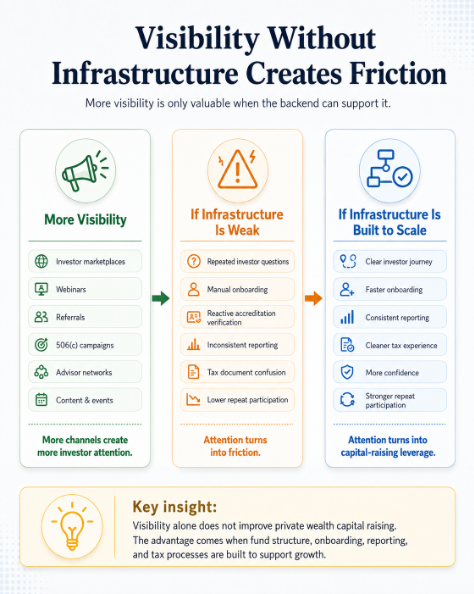
For fund managers, sponsors, and syndicators, that sounds like good news. More investors. More capital channels. More ways to grow beyond personal networks, referrals, webinars, investor marketplaces, and in some cases, 506(c) campaigns.
But more visibility does not just create more opportunity.
It creates more operational exposure.
Getting in front of more accredited investors does not automatically mean you are ready to raise from them. A 506(c) structure may allow managers to market more openly, but as we explored in our blog on how 506(c) changes the fundraising motion, the broader point applies across capital-raising channels: the more investors you reach, the more pressure you put on your onboarding, accreditation verification, reporting, tax process, communication, and follow-through.
That is where many managers hit the private wealth investor experience gap.
Private wealth investors may be open to alternative investments, but they still expect the process to feel clear, organized, and professional. If your backend depends on scattered documents, manual follow-ups, disconnected entities, and inconsistent updates, more attention can quickly turn into more friction.
This blog breaks down where that gap shows up, why it matters in 2026, and how fund managers can close it with better infrastructure, not just more marketing.
The Gap Shows Up When Visibility Turns Into Volume
The private wealth investor experience gap is the difference between what modern investors expect and what many private fund structures are built to deliver.
In this context, private wealth includes high-net-worth investors, family offices, RIAs, and accredited investors accessing private markets through direct relationships, marketplaces, webinars, or 506(c) campaigns.
Most managers do not notice the gap when they are raising from a small circle. They notice it when visibility turns into volume.
A few familiar signs:
- Prospects ask the same questions repeatedly.
- Subscription documents move slowly.
- Accreditation verification feels manual or reactive.
- Updates vary from deal to deal.
- Tax questions create friction after the investment.
- Investors like the opportunity but hesitate because the process feels unclear.
- Participating in the next deal feels like starting over.
This is not just an investor portal issue. It is a structure, operations, reporting, and communication issue.
The investor experience is shaped long before the first update goes out. It is shaped by how the fund is built.
Why 2026 Is Raising the Standard
Private wealth capital is becoming a bigger part of the private markets conversation. Hamilton Lane’s 2026 Global Private Wealth Survey found that 86% of private wealth professionals plan to increase allocations to private market investments.
That is a strong signal. Private wealth investors and advisors are not just curious about private markets. Many are actively looking at them.
But more interest does not mean easier fundraising.
It means more investors need to understand the opportunity, complete onboarding, evaluate risk, receive updates, handle tax documents, and feel confident enough to participate again.
At the same time, PwC’s 2026 Private Capital Outlook notes that private capital managers are operating in a market shaped by tighter liquidity, longer hold periods, investor scrutiny around after-tax returns, and the growth of retail capital as a fundraising source.
That raises the bar for fund managers.
Private wealth investors may understand that private investments are less liquid and more complex than public market products. But they still expect a professional experience. RIAs raise the bar even further because they are not only evaluating the investment for themselves. They are deciding whether they are comfortable introducing that opportunity to clients.
They need answers to practical questions:
- What is the structure?
- Who is eligible to invest?
- How does onboarding work?
- What reporting will investors receive?
- When should investors expect tax documents?
- What are the liquidity expectations?
- How easy is it to participate in future opportunities?
If those answers are unclear, trust weakens before capital is ever committed.
Deal-by-Deal Works Until the Backend Becomes the Bottleneck
Deal-by-deal capital raising works for a reason.
It gives investors choice. It lets them evaluate each opportunity on its own merits. It gives managers a practical way to raise around specific deals, assets, or strategies.
But it does have a ceiling.
That ceiling shows up when every new opportunity creates almost as much operational work as the first one.
A new raise often means new documents, new workflows, new investor questions, new reporting formats, and new tax considerations. At a small scale, that can work. At a larger scale, it starts to strain the manager and the investor.
The issue is not investor choice. The issue is when investor choice is delivered through infrastructure that was never designed to scale.
That is where deal-by-deal fundraising can start creating:
- Investor fatigue
- Manager bandwidth issues
- Inconsistent communication
- Fragmented tax and reporting workflows
- Slower follow-up
- Lower repeat participation
Investors may want the ability to choose opportunities. They do not want each opportunity to feel like starting from zero.
What Private Wealth Investors Need Before They Commit
Private wealth investors are not only evaluating the deal. They are evaluating the manager’s ability to run the process professionally. Before they commit, they usually need five things.
Clarity
They need to understand the strategy, risk profile, fees, timeline, liquidity expectations, and reporting process without piecing together information from multiple places.
Confidence
They want to know the manager has a repeatable process, not just access to a strong opportunity. This reduces hesitation and helps investors move from interest to commitment.
Simple Onboarding
Investor onboarding should feel organized. Subscription documents, qualification steps, accreditation verification, funding instructions, and next steps should not feel improvised.
Consistent Reporting
Private fund investor reporting does not need to look like public-market reporting. But it does need to be clear, timely, and predictable enough to support investor confidence.
Tax Simplicity
Tax reporting is part of the investor experience. If investors receive multiple K-1s, unclear timelines, or scattered documents, that friction affects how they feel about investing again.
The larger point is simple: in private markets, trust is not built only through performance. It is built through the full experience before, during, and after the investment.
The Three Layers of Investor Experience
Many fund managers try to improve investor experience with better pitch decks, better emails, or better follow-up.
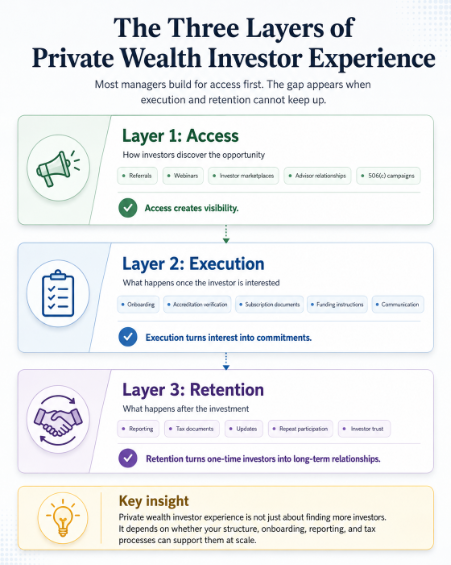
Those things help. But they do not solve the deeper issue. A better investor experience has three layers.
1. Access
This is how investors find the opportunity.
Access may come through referrals, webinars, investor marketplaces, advisor relationships, content, events, or 506(c) campaigns.
Most managers focus heavily here because access is visible. More leads feel like progress. More conversations feel like momentum.
But access is only the first layer.
2. Execution
This is what happens once an investor is interested.
Can they understand the opportunity? Can they complete onboarding without confusion? Is accreditation verification handled properly? Are documents organized? Are next steps clear? Does the process build trust, or does it create doubt?
This is where many managers lose momentum.
A strong campaign can create investor interest. But a weak execution layer can slow commitments.
3. Retention
This is what happens after the investment.
Are updates consistent? Is reporting clear? Are tax documents handled professionally? Does the investor understand what is happening with the investment? Is it easy for them to participate again?
Retention is where one-time investors become long-term capital relationships.
The problem is that many fund managers build for access before they build for execution and retention. They focus on getting in front of more investors before they have the infrastructure to support what happens next.
That is the private wealth investor experience gap.
Better Fund Infrastructure Closes the Gap
Investor experience is often a fund structure decision.
As we’ve written before, fund design shapes investor decision-making, because structure affects how investors understand the opportunity, evaluate risk, and decide whether the process feels built for scale.
A traditional blind-pool fund may be efficient for managers, but it can limit investor choice.
One-off SPVs or syndications may offer more choice, but they can create fragmentation as the number of deals and investors grows.
The real opportunity is to build scalable fund infrastructure that supports both sides:
- Choice for investors
- Operational scale for managers
That means managers need more than another tool. They need an operating model that connects structure, onboarding, compliance, reporting, tax, communication, and repeat participation.
Without that connection, every growth channel creates more operational drag.
With that connection, private wealth capital raising becomes less about chasing attention and more about building trust at scale.
How Avestor Helps Fund Managers Close the Gap
At Avestor, we believe fund managers should not have to choose between investor flexibility and operational scale.
That belief is built into Avestor’s 6 Pillars of Growth: Technology, Services, Community, Education, Marketplaces, and Support.
These pillars are not standalone features. They are designed to work together as the structural foundation behind scalable capital raising.
Here is how they help close the investor experience gap.
Technology helps solve manual onboarding, fragmented documentation, compliance workflows, and fund flows, so managers are not rebuilding the process for every raise.
Services help reduce vendor coordination across legal, compliance, banking, accounting, and tax. That matters because investor experience often breaks when too many critical workflows sit in disconnected places.
Community gives fund managers access to shared experience and peer learning, so they can understand how other managers are solving similar structure, investor communication, and scaling challenges.
Education helps managers make better decisions before problems compound. Clearer structure and stronger investor communication usually start with better context.
Marketplaces help expand visibility through investor and manager networks, but visibility only works when the structure behind it can support the attention it creates.
Support gives managers guidance at key inflection points, from fund launches and restructures to investor questions, operational decisions, and growth planning.
The important part is integration.
Most platforms solve one piece of the problem. Avestor is designed to connect the pieces that matter across the capital-raising lifecycle.
That is also why the Customizable Fund® structure matters. It helps managers offer investors deal-by-deal participation while supporting a more streamlined fund structure, administration process, reporting experience, and tax experience.
Investor choice should not create operational chaos. And scale should not require managers to give up flexibility.
Private Wealth Is Ready. Your Infrastructure Has to Be Too.
Private wealth capital is not just asking fund managers to be more visible.
It is asking them to be more prepared.
More investors, investor marketplaces, webinars, and 506(c) campaigns can expand reach. But reach alone does not create trust. Trust is built when the investor experience feels clear, consistent, and repeatable.
If your infrastructure is fragmented, more attention can create more strain.
If your infrastructure is built for scale, more attention can become a real capital-raising advantage.
That is the real opportunity.
Not just more capital.
Better infrastructure for the capital you are trying to raise.
If you are building beyond one-off raises, Avestor can help you create a fund structure and operating system designed for investor choice, scalable growth, and a better private market investor experience.
Connect with us here.